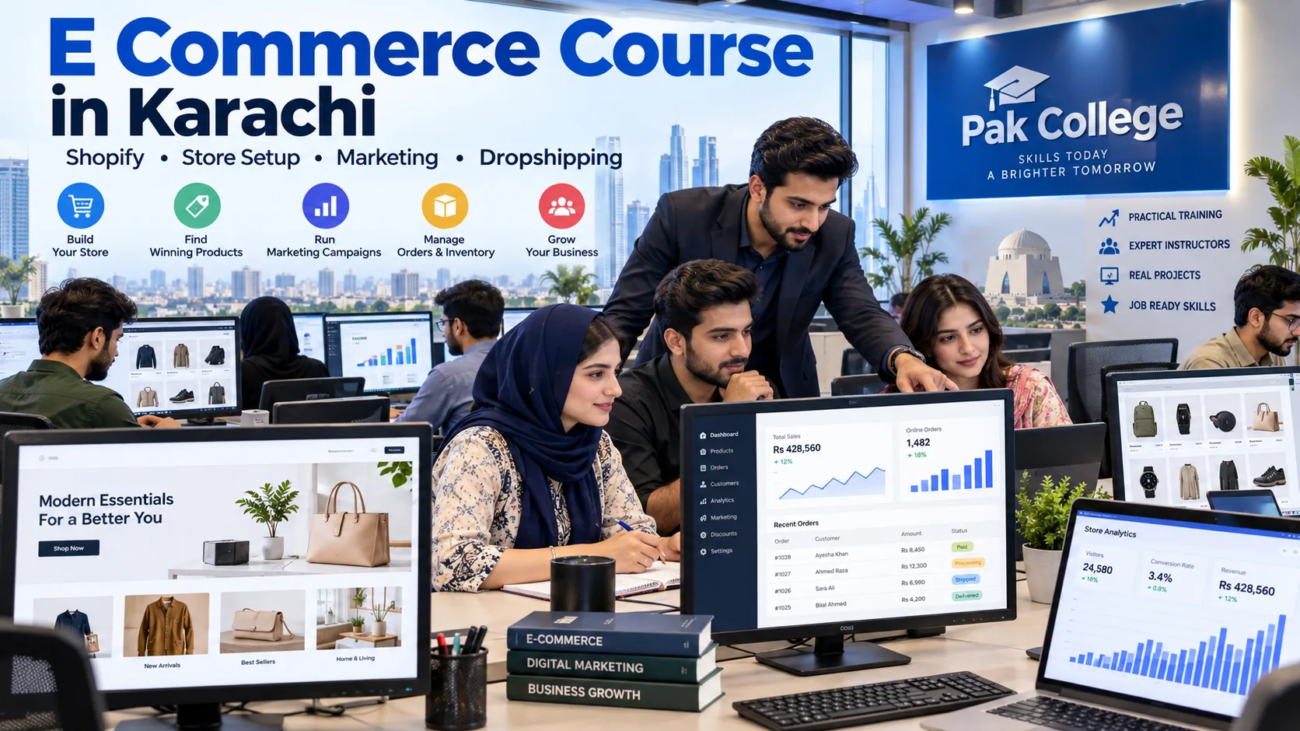
Online shopping has changed how businesses sell products and how entrepreneurs reach customers. Today, a business can build an online store, display products, process orders, promote products digitally and serve customers without depending entirely on a physical shop.
For students, entrepreneurs and freelancers who want to understand this growing business model, an E Commerce Course in Karachi can provide practical knowledge about online stores, product management, Shopify, digital marketing and dropshipping.
Students can also explore Pak College’s Shopify E-Commerce Course in North Nazimabad, which focuses on practical Shopify store setup, themes, e-commerce pages, product research and other store-management skills.
What Is an E Commerce Course?
An e-commerce course teaches learners how products and services can be sold through digital platforms.
Students can learn how an online store works from the moment a product is added until a customer places an order.
E-commerce training may cover:
- Online store setup
- Product research
- Shopify
- Product pages
- Store design
- Navigation menus
- Store policies
- Digital marketing
- Dropshipping
- Customer journey
- Basic analytics
- Product promotion
The objective is not simply to learn how to create a website.
A complete e-commerce skill set also requires understanding products, customers, marketing, store management and online sales processes.
What Is E Commerce?
E-commerce, or electronic commerce, refers to buying and selling products or services through online channels.
Businesses can sell through:
- Their own online stores
- E-commerce platforms
- Online marketplaces
- Social media
- Mobile applications
For example, a clothing business can create an online Shopify store, upload products, display prices and descriptions, receive customer orders and manage its digital storefront from one platform.
Shopify’s official documentation explains that its platform provides tools for creating an online store, displaying products and managing different parts of an online business.
This is why platforms such as Shopify are commonly included in modern e-commerce training.
What Will You Learn in an E Commerce Course in Karachi?
A practical E Commerce Course in Karachi should help students understand how an online business works rather than teaching only one software tool.
Let’s look at some of the major skills students may develop.
Shopify Store Setup
Shopify is a popular platform used to create and manage online stores.
Students learning Shopify may practice:
- Creating a Shopify account
- Understanding the Shopify dashboard
- Selecting a theme
- Customizing a store
- Creating product pages
- Adding collections
- Setting navigation
- Creating store policies
- Organizing store content
Pak College’s Shopify E-Commerce Course in North Nazimabad currently includes Shopify account and theme setup, e-commerce homepage creation, menu and policy configuration, pixel configuration and product research.
This makes Shopify a useful starting point for students who want practical exposure to e-commerce store management.
E-Commerce Store Design
A successful online store should be easy for customers to understand and navigate.
Students should learn how to structure:
- Homepage
- Product pages
- Product categories
- Navigation menus
- Contact information
- Policy pages
- Calls to action
- Product images
- Store branding
A clean store design can help customers find products more easily.
Students interested in learning deeper website-design concepts can also explore Pak College’s Smart Web Designing Course in Karachi, which covers HTML, CSS, Bootstrap and introductory SEO concepts.
Product Research
One of the most important e-commerce skills is choosing what to sell.
A store may look professional, but it still needs products that match customer demand.
Product research can involve:
- Understanding customer needs
- Studying competitors
- Comparing products
- Evaluating pricing
- Reviewing demand
- Analyzing product positioning
- Identifying potential niches
Students should learn that product research is not about finding a guaranteed “winning product.”
Every product involves competition, costs, customer expectations and business risk.
The goal is to make better-informed decisions using research.
Creating Product Pages
Product pages are where customers decide whether a product is relevant to them.
Students can learn how to create product listings containing:
- Product title
- Product description
- Product images
- Price
- Variants
- Product benefits
- Shipping information
- Calls to action
Good product information should be accurate and useful.
It should answer common customer questions without making misleading claims.
E-Commerce Navigation and Store Policies
Online stores need more than products.
Customers also need to understand how the business operates.
Students may learn how to create and organize pages related to:
- Shipping
- Returns
- Refunds
- Privacy
- Terms
- Contact information
Navigation menus should make important sections of the store easy to find.
Pak College’s Shopify E-Commerce training specifically includes menu creation and policy linking as part of the course outline.
Dropshipping
Dropshipping is a business model in which a store may sell products without keeping all inventory itself, while a supplier handles fulfillment.
An e-commerce course may introduce students to:
- Product research
- Supplier selection
- Store setup
- Pricing
- Product listings
- Marketing
- Order workflow
- Customer communication
However, dropshipping is not guaranteed income.
Students should understand costs, competition, supplier reliability, refunds, advertising and customer service before treating it as a business opportunity.
Digital Marketing for E Commerce
Building a store is only one part of e-commerce.
Customers also need to discover the products.
That’s why digital marketing skills are highly relevant to e-commerce.
Common areas include:
- SEO
- Social media marketing
- Google Ads
- Meta Ads
- Email marketing
- Content marketing
- Retargeting
- Conversion optimization
Students who want deeper marketing skills can explore Pak College’s Digital Marketing Course in Karachi, which includes Social Media Marketing, WordPress, SEO, Email Marketing, Dropshipping and Graphic Designing.
Combining e-commerce with digital marketing can help students understand both store creation and customer acquisition.
Search Engine Optimization for E-Commerce Stores
SEO helps search engines understand website pages and products.
For e-commerce stores, SEO can involve:
- Product keywords
- Product titles
- Product descriptions
- Category pages
- Internal links
- Image optimization
- Technical website structure
- Helpful content
An online shop may have many product pages, making organization particularly important.
Students should understand that SEO is a long-term process rather than an instant traffic method.
Google Merchant Center for Online Stores
Google Merchant Center can help businesses manage product information so products can appear across Google surfaces.
Google’s official Merchant Center documentation explains that merchants can add and manage product data and, in some cases, connect platforms such as Shopify directly with Merchant Center.
This is useful knowledge for students interested in e-commerce marketing because product feeds can play an important role in how online products are represented across Google.
Social Media Marketing for E Commerce
Platforms such as Facebook and Instagram are commonly used to introduce products to potential customers.
E-commerce marketers may work on:
- Product creatives
- Promotional content
- Audience targeting
- Social media pages
- Paid campaigns
- Retargeting
- Customer engagement
Students should learn the relationship between the product, target audience, advertisement and landing page rather than focusing only on pressing the “boost” button.
Graphic Design for Online Stores
Visual presentation matters in e-commerce.
Online stores regularly require:
- Product banners
- Promotional graphics
- Social media posts
- Product images
- Advertising creatives
- Website banners
Students who want to develop deeper creative skills can explore Pak College’s Graphic Design Course in Karachi, which currently covers Adobe Photoshop, Illustrator, Premiere, After Effects and Canva.
Graphic design and e-commerce work particularly well together because online businesses need visual content constantly.
E Commerce Course in Karachi for Beginners
Beginners can learn e-commerce without already being professional programmers.
Many modern e-commerce platforms provide visual interfaces for common store-management tasks.
A beginner can gradually learn:
- How e-commerce works.
- How an online store is structured.
- How Shopify works.
- How products are added.
- How store pages are created.
- How marketing attracts customers.
- How orders are managed.
- How store performance is reviewed.
However, learning basic web, marketing and design concepts can make a learner more capable over time.
Students do not need to master everything on day one.
Who Should Take an E Commerce Course?
An E Commerce Course in Karachi can be useful for several types of learners.
Students
Students can learn how modern online businesses operate and develop practical digital skills.
Entrepreneurs
Business owners can learn how to create and manage an online sales channel.
Freelancers
Freelancers can potentially offer services such as Shopify store setup, product uploading, website management and store customization.
Small Business Owners
Existing retailers can learn how an online store may complement a physical business.
Digital Marketers
Marketers can develop a better understanding of the e-commerce stores to which they send advertising traffic.
Beginners
People with limited previous e-commerce experience can begin with store fundamentals before moving toward more advanced marketing and technical topics.
E Commerce Course vs Shopify Course
Students often use the terms E Commerce Course and Shopify Course interchangeably, but they are not exactly the same.
E-commerce is the broader subject.
It can include:
- Products
- Customers
- Online business models
- Store platforms
- Marketing
- Payments
- Fulfillment
- Analytics
- Customer service
Shopify is one platform that can be used to build and manage an online store.
Therefore, Shopify can be a major component of an e-commerce course, but e-commerce itself is broader than Shopify.
Students specifically interested in practical Shopify skills can explore Pak College’s Shopify E-Commerce Course in North Nazimabad.
E Commerce Course vs Digital Marketing Course
E-commerce and digital marketing also overlap, but they have different primary focuses.
An E Commerce Course focuses mainly on operating an online selling environment.
A Digital Marketing Course focuses more on attracting, engaging and converting audiences through channels such as:
- SEO
- Social media
- Paid advertisements
- Content
An e-commerce store needs marketing, so the two skill sets complement each other.
Students interested in both can combine e-commerce training with Pak College’s Digital Marketing Course in Karachi.
Career Opportunities After an E Commerce Course
Completing a course does not guarantee employment, but the skills can support several possible career paths depending on experience and ability.
Learners may explore roles such as:
- Shopify Store Assistant
- E-Commerce Assistant
- Product Listing Executive
- Online Store Administrator
- E-Commerce Coordinator
- Marketplace Assistant
- Product Research Assistant
- Digital Marketing Assistant
- Shopify Freelancer
- Store Management Assistant
Entrepreneurially minded students may also use the skills to experiment with their own online business.
However, real results depend on product selection, customer demand, marketing, capital, operations and consistent work.
Freelancing Opportunities After Learning E Commerce
E-commerce skills can also be offered as freelance services.
Possible services include:
- Shopify store setup
- Theme configuration
- Product uploads
- Store navigation setup
- Product-page formatting
- Collection creation
- Policy-page setup
- Basic store management
- E-commerce graphics
- Website content updates
Students interested in freelancing should develop a portfolio showing what they can actually build.
A sample Shopify store can be more useful than simply stating “Shopify expert” on a profile.
E Commerce Course Scope in Pakistan
Businesses in Pakistan increasingly use websites, social media and digital channels to reach customers.
This creates opportunities for people who understand:
- Online store management
- Digital marketing
- Product listings
- Shopify
- Website management
- Graphic content
- Online customer journeys
However, students should avoid assuming that learning e-commerce automatically creates a profitable business.
E-commerce combines multiple skills and business decisions.
A successful online operation may need the right product, competitive pricing, reliable fulfillment, effective marketing and strong customer service.
That is why practical learning is important.
E Commerce Course Near Me
Users searching for an e commerce course near me are usually looking for practical training that is easily accessible from their location.
Pak College is located at Al-Burhan Circle, Main Haideri Green Line, Block-E, North Nazimabad, Karachi.
Students in North Nazimabad and nearby Karachi areas can explore Pak College’s Shopify E-Commerce Course, which currently includes hands-on store-related topics and a final project.
Physical training can be useful for beginners who prefer instructor guidance while creating their first store.
How to Choose an E Commerce Course in Karachi
Before selecting an institute, check whether the course teaches practical skills.
Shopify Store Setup
Students should ideally practice creating an actual online store.
Product Research
The course should explain how products and competition can be evaluated.
Store Design
Students should understand homepage, product-page and navigation structure.
Marketing
At least basic digital-marketing concepts are useful.
Practical Project
Projects can help students apply the concepts they learn.
Trainer Guidance
Beginners often benefit from being able to ask questions while working on their stores.
Updated Curriculum
E-commerce platforms change regularly, so students should learn current workflows rather than outdated interfaces.
Why Consider Pak College for E-Commerce Training?
Pak College offers a Shopify E-Commerce Course in North Nazimabad, Karachi.
Its current curriculum includes:
- Introduction to Shopify
- Shopify account and theme setup
- Shopify store creation
- E-commerce homepage setup
- Navigation menus
- Policy linking
- Pixel configuration
- Dropshipping product research
The course page also lists a final project.
Students who want complementary skills can also explore Pak College’s Digital Marketing Course in Karachi, Graphic Design Course in Karachi, and Smart Web Designing Course.
Together, these learning paths can help students develop broader skills across e-commerce, marketing, design and websites.
Frequently Asked Questions
What is an E Commerce Course?
An E Commerce Course teaches the fundamentals of selling products online, including online stores, Shopify, product management, store design, marketing and related business processes.
Which E Commerce Course is suitable for beginners in Karachi?
Beginners should look for training that starts with store fundamentals and provides practical exercises. Pak College offers Shopify-focused e-commerce training in North Nazimabad, Karachi.
Do I need coding knowledge for an E Commerce Course?
Basic Shopify store management does not necessarily require advanced programming knowledge. However, understanding web design and technical concepts can become useful as you progress.
What is Shopify?
Shopify is an e-commerce platform used to create and manage online stores, products, themes and sales-related workflows.
Does an E Commerce Course include dropshipping?
Some e-commerce programs include dropshipping concepts. Pak College’s current Shopify E-Commerce curriculum includes dropshipping product research.
Can I freelance after learning Shopify?
Shopify skills can be offered through services such as store setup, product uploading and store management. Freelance success depends on practical skills, portfolio quality and client acquisition.
What is the difference between E Commerce and Digital Marketing?
E-commerce focuses on online selling and store operations, while digital marketing focuses on attracting and converting audiences through channels such as SEO, advertising, social media and email.
What jobs can I explore after an E Commerce Course?
Depending on skills and experience, learners may explore roles including E-Commerce Assistant, Shopify Store Assistant, Product Listing Executive and Digital Marketing Assistant.
Where can I learn E Commerce in Karachi?
Pak College offers Shopify-focused e-commerce training from its North Nazimabad campus in Karachi.
Is E Commerce useful for business owners?
Yes. Understanding e-commerce can help business owners better understand online stores, products, digital customers and marketing. Business results, however, depend on many additional factors.
Start Learning E-Commerce Skills in Karachi
An E Commerce Course in Karachi can help students, freelancers and business owners understand how modern online stores operate.
Learning Shopify, product management, store design, product research and digital marketing can provide a useful foundation for working with online businesses.
Students who want practical Shopify training can explore Pak College’s Shopify E-Commerce Course in North Nazimabad, while complementary programs such as Digital Marketing, Graphic Design and Web Designing can help develop broader digital skills.
The key is to learn the fundamentals, build practical projects and continue improving your skills as e-commerce platforms evolve.