
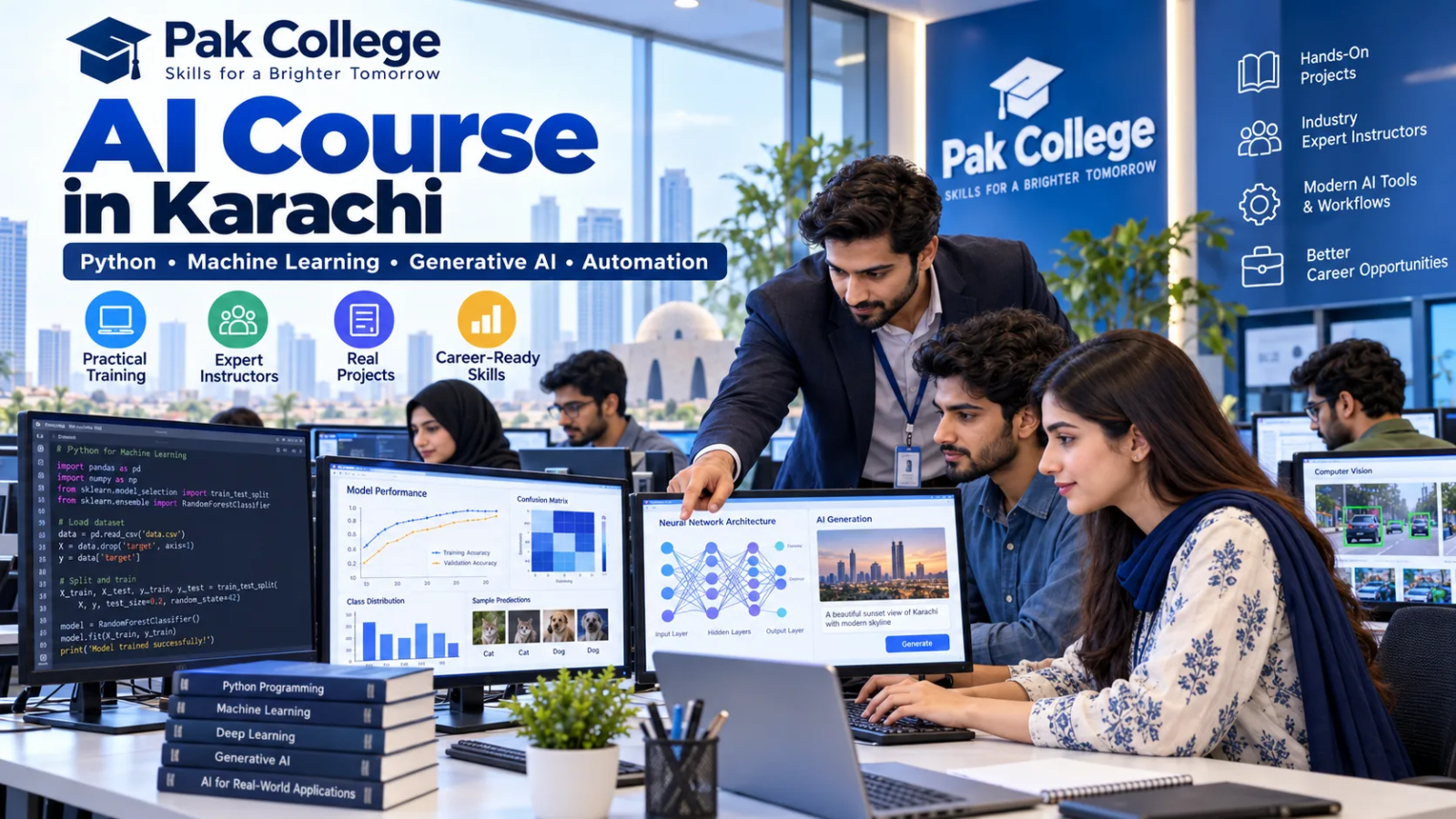
Artificial Intelligence is rapidly changing how businesses, developers, marketers and professionals work. From intelligent automation and data analysis to generative AI and machine learning, AI skills are becoming increasingly relevant across different industries.
For students and professionals who want to build practical technology skills, joining an AI Course in Karachi can provide a structured path to learning Python, machine learning, prompt engineering, automation and modern Artificial Intelligence tools.
Pak College offers practical Artificial Intelligence training from its North Nazimabad campus in Karachi, with a curriculum covering foundational AI concepts as well as hands-on technologies.
What Is an AI Course?
An AI course teaches students how computers can use data, algorithms and models to perform tasks that normally require human-like intelligence.
These tasks can include:
- Understanding text
- Recognizing images
- Analyzing data
- Making predictions
- Generating content
- Automating repetitive tasks
- Building intelligent applications
- Processing large datasets
Modern AI training can combine programming, data analysis, machine learning and generative AI.
A beginner does not need to understand every advanced AI concept before starting. A structured learning path can begin with fundamentals and gradually progress toward practical projects.
Why Learn Artificial Intelligence in 2026?
Artificial Intelligence is no longer limited to research laboratories.
AI tools are now being used in:
- Software development
- Marketing
- Finance
- Healthcare
- Customer service
- Education
- Data analysis
- E-commerce
- Cyber security
- Business automation
The Stanford AI Index Report 2026 shows continued growth in AI adoption and AI-related skills. It also reports that Python, automation, workflow management, data analysis and data science were among prominent skills appearing in AI-related job postings in 2025.
This does not mean completing one course guarantees an AI job. However, it does show why practical AI, programming and data skills are increasingly useful for students building technology careers.
What Will You Learn in an AI Course in Karachi?
Pak College’s Artificial Intelligence curriculum currently includes several areas relevant to modern AI learning.
These include:
- Introduction to Artificial Intelligence
- AI concepts
- AI image generation
- AI video generation
- AI text generation
- Prompt engineering
- AI automation
- Code generation using AI
- Core Python
- NumPy
- Pandas
- TensorFlow
- Scikit-learn
- OpenCV
The dedicated Pak College Artificial Intelligence course is currently listed as a 3-month program, with seminars, workshops and final projects included.
Let’s look at some of these areas in more detail.
Python Programming for Artificial Intelligence
Python is one of the most important programming languages for Artificial Intelligence and data-related work.
Students learning AI may use Python to:
- Write programs
- Process data
- Automate tasks
- Work with AI libraries
- Build machine learning models
- Analyze datasets
- Develop prototypes
Python’s official documentation describes it as a powerful language suitable for scripting and rapid application development, while its large ecosystem makes it particularly useful for technical projects.
For beginners, the most important step is not memorizing every Python command.
Instead, students should understand concepts such as:
- Variables
- Data types
- Conditions
- Loops
- Functions
- Lists
- Dictionaries
- File handling
- Basic object-oriented programming
Once these foundations are clear, learning AI libraries becomes much easier.
NumPy and Pandas for Data
AI systems often depend on data.
Therefore, students should understand how to organize, manipulate and analyze information.
NumPy
NumPy is widely used for numerical operations and working with arrays.
Students may use it to understand:
- Numerical data
- Arrays
- Mathematical operations
- Data transformations
Pandas
Pandas is commonly used for structured data.
Students can use it to:
- Read datasets
- Clean information
- Filter records
- Handle missing values
- Analyze tables
- Prepare data for machine learning
These skills are particularly useful because machine learning models depend heavily on the quality and structure of their input data.
Machine Learning Fundamentals
Machine learning is an important branch of Artificial Intelligence.
Instead of manually programming every possible rule, machine learning models can learn patterns from data.
Students may encounter concepts such as:
- Training data
- Testing data
- Features
- Labels
- Regression
- Classification
- Supervised learning
- Unsupervised learning
- Model evaluation
A practical AI course should help students understand the concepts rather than simply running copied code.
Scikit-Learn
Scikit-learn is commonly used for introductory machine learning work in Python.
Students can use machine learning libraries to practice:
- Regression
- Classification
- Clustering
- Data preprocessing
- Model testing
- Prediction
The objective should be to understand why a model is being used, what data it requires and how its performance is evaluated.
Deep Learning and TensorFlow
Deep learning uses neural-network-based methods to solve more complex AI problems.
These methods can be applied to areas such as:
- Image recognition
- Natural language processing
- Prediction
- Computer vision
- Pattern recognition
TensorFlow provides official educational resources covering machine learning foundations, neural networks and deep-learning concepts for learners who want to continue practicing beyond classroom training.
Students should generally build a foundation in Python and basic machine learning before moving too deeply into neural-network concepts.
Computer Vision with OpenCV
Computer vision focuses on helping computers understand images and video.
Potential applications include:
- Object detection
- Image processing
- Face-related image analysis
- Document scanning
- Visual inspection
- Video processing
OpenCV is a popular computer-vision library and appears in Pak College’s current AI course outline.
Students learning computer vision should ideally work on practical mini-projects so they can understand how image data is processed programmatically.
Generative AI
Generative AI refers to systems capable of creating new content such as:
- Text
- Images
- Code
- Audio
- Video
Modern generative AI tools have made Artificial Intelligence accessible to many users who are not traditional machine-learning engineers.
However, professional AI skills involve more than simply entering prompts into a chatbot.
Students should understand:
- What generative AI can do
- Its limitations
- Prompt design
- Output evaluation
- Hallucinations and errors
- Responsible use
- Automation workflows
This helps students use AI as a tool rather than accepting every generated output without evaluation.
Prompt Engineering
Prompt engineering involves structuring instructions and context so an AI model can produce more useful outputs.
Students may practice:
- Clear instructions
- Context setting
- Output formatting
- Role-based prompts
- Multi-step tasks
- Examples
- Constraints
- Iterative improvement
Prompt engineering is useful in areas such as:
- Content creation
- Coding assistance
- Research
- Business workflows
- Customer support
- Marketing
- Automation
However, good prompts still require human judgment.
Students should always review AI-generated information for accuracy.
AI Automation
Automation is one of the most practical applications of Artificial Intelligence.
Businesses often repeat tasks involving:
- Data entry
- Reports
- Emails
- Content preparation
- Information processing
- Customer requests
- Document workflows
AI can sometimes assist with these processes.
Pak College’s current AI curriculum includes automation with AI using Google Script, allowing students to explore how AI can be connected with workflow automation.
AI automation skills can be particularly useful for students interested in business productivity and freelance technology services.
AI Code Generation
Modern AI assistants can help developers:
- Generate starter code
- Explain programming concepts
- Debug errors
- Refactor code
- Create test cases
- Document software
However, students should avoid becoming completely dependent on AI-generated code.
A learner should still understand:
- What the code does
- Why it works
- Whether it is secure
- Whether the output is accurate
- How to troubleshoot it
This is why learning core Python remains important even when AI tools can generate code automatically.
AI Course in Karachi for Beginners
Students often ask whether they can learn Artificial Intelligence without a computer science degree.
Beginners can start learning AI, but the learning process should be progressive.
A suitable path may look like:
- Computer fundamentals
- Basic programming logic
- Python
- Data handling
- Machine learning concepts
- AI libraries
- Generative AI
- Automation
- Practical projects
Students should not worry if machine learning terminology initially sounds complicated.
Concepts become easier when learners combine explanations with practical examples.
Do You Need Mathematics for AI?
Some AI and machine learning concepts involve mathematics.
Useful areas can include:
- Basic algebra
- Statistics
- Probability
- Functions
- Graphs
However, beginners do not necessarily need advanced mathematics before taking their first AI course.
The required mathematical depth depends on how advanced the student wants to go.
Someone building simple automation workflows may need less mathematical knowledge than someone planning to become a machine learning researcher.
AI Course in Karachi for Students
AI can be particularly relevant for:
Computer Science Students
AI skills can complement programming and software development knowledge.
IT Students
Students from general IT backgrounds can use AI training to explore a specialized technology field.
Intermediate Students
Motivated students can begin with basic Python and AI fundamentals before moving toward advanced topics.
University Students
AI projects can strengthen practical portfolios alongside academic studies.
Working Professionals
Professionals can learn how AI applies to automation, analysis and their existing industry.
Freelancers
Freelancers can combine AI with existing skills such as web development, marketing and business automation.
AI Course vs Machine Learning Course
Artificial Intelligence is the broader field.
Machine learning is one area within AI.
An AI course may include:
- Generative AI
- Automation
- Machine learning
- Programming
- Computer vision
- Data processing
- AI applications
A dedicated machine learning course may focus more deeply on:
- Algorithms
- Model training
- Statistics
- Data science
- Evaluation
- Prediction
Therefore, students should look at the actual syllabus instead of selecting a course only by its name.
AI Course vs Data Science
AI and data science overlap, but they are not identical.
Data science focuses heavily on:
- Collecting data
- Cleaning data
- Analyzing information
- Visualization
- Statistics
- Drawing insights
Artificial Intelligence focuses more broadly on creating systems capable of intelligent tasks.
Skills such as Python, NumPy and Pandas can be useful in both fields.
AI and Web Development
AI applications often need user interfaces.
For example, a developer may create:
- AI chatbot websites
- Recommendation systems
- AI dashboards
- Automation portals
- Intelligent web tools
This is why AI and web development can complement each other.
Students who want broader website-development skills can also explore Pak College’s Full Stack or Web Development programs alongside AI training.
AI and Cyber Security
Artificial Intelligence also has applications in cyber security.
Security teams may use automation and intelligent systems to assist with:
- Threat detection
- Log analysis
- Anomaly detection
- Security monitoring
- Incident prioritization
At the same time, AI systems themselves need to be used securely.
Students interested in information security can complement their AI knowledge with Pak College’s Cyber Security training.
AI and Digital Marketing
Artificial Intelligence is increasingly used in digital marketing for:
- Content ideas
- Data analysis
- Ad copy
- Customer segmentation
- Marketing automation
- Keyword research
- Reporting
- Creative workflows
However, marketers still need to understand audience intent, strategy and campaign measurement.
AI should support marketing judgment rather than replace it.
Students interested in combining AI with business promotion can also explore Pak College’s Digital Marketing training.
Career Paths After Learning AI
An AI course alone does not guarantee a job.
However, students who continue practicing, build projects and develop deeper technical skills may explore career directions such as:
- Junior AI Developer
- Python Developer
- Machine Learning Intern
- Data Analyst
- AI Automation Assistant
- Junior Machine Learning Engineer
- AI Application Developer
- Computer Vision Learner
- Generative AI Developer
- Data Science Intern
Actual job eligibility depends on education, portfolio, programming ability, mathematical understanding and employer requirements.
Freelancing With AI Skills
AI can also complement freelance services.
Possible service areas may include:
- AI-powered automation
- Chatbot integration
- Python scripting
- Data processing
- Prompt workflows
- AI-assisted websites
- Business automation
- AI content workflows
Students should avoid selling services they do not yet understand.
Building several practical projects first is a better approach.
Projects to Build During an AI Course
Projects help demonstrate practical ability.
Beginner-friendly ideas can include:
- Simple Python chatbot
- Text classification project
- Basic recommendation system
- Image classification demo
- Data-analysis dashboard
- Automated reporting workflow
- AI-powered FAQ assistant
- Simple computer-vision application
A small project that actually works can be more useful for learning than copying a complicated project without understanding it.
Why Practical AI Training Matters
Artificial Intelligence cannot be learned effectively by memorizing definitions alone.
Students should spend time:
- Writing Python code
- Cleaning datasets
- Training basic models
- Testing AI tools
- Debugging errors
- Creating automation
- Completing projects
Pak College’s dedicated AI course currently includes workshops, seminars and final projects alongside its 3-month curriculum.
Practical work helps students understand how theoretical concepts behave in real situations.
AI Course in North Nazimabad, Karachi
Students looking for physical AI training in Karachi can consider accessibility as part of their decision.
Pak College is located at Al-Burhan Circle, Main Haideri Green Line, Block-E, North Nazimabad, Karachi.
Its Artificial Intelligence course currently covers AI concepts, prompt engineering, generative AI, automation, Python and multiple AI/data libraries.
Students living in North Nazimabad and surrounding parts of Karachi can therefore explore the program according to their learning goals and schedule.
How to Choose an AI Course in Karachi
Before enrolling, consider the following factors.
Python Training
A strong foundation in Python is valuable for serious AI learning.
Practical Projects
Students should ideally build rather than only watch demonstrations.
Machine Learning Fundamentals
The course should explain how models learn from data.
Modern AI Topics
Generative AI and automation are useful additions to traditional machine-learning concepts.
Data Libraries
Exposure to tools such as NumPy and Pandas helps students understand data processing.
Learning Progression
The course should move logically from beginner concepts toward more advanced topics.
Instructor Guidance
AI can involve difficult concepts, so students should have opportunities to ask questions.
Career Expectations
Avoid institutes that promise guaranteed jobs, guaranteed salaries or instant expertise.
AI requires continuous practice.
Frequently Asked Questions
What is the best AI Course in Karachi for beginners?
Beginners should look for an AI course that begins with Python and basic AI concepts before progressing toward machine learning, generative AI and practical projects.
Can I learn AI without coding experience?
Yes, beginners can start learning AI. However, programming—particularly Python—becomes important for more technical AI and machine-learning work.
What programming language is used for Artificial Intelligence?
Python is widely used in AI, machine learning and data science because of its large ecosystem of libraries and tools.
What does Pak College’s AI course cover?
The current curriculum includes AI concepts, generative content, prompt engineering, automation, code generation, Core Python, NumPy, Pandas, TensorFlow, Scikit-learn and OpenCV.
How long is the AI Course at Pak College?
The current dedicated Artificial Intelligence course page lists a duration of 3 months.
Is AI difficult for beginners?
Some concepts can initially be challenging, particularly programming and mathematics. A structured learning path and regular practice can make them easier to understand.
Does an AI course include machine learning?
A comprehensive AI program may include machine learning as one of its core areas. Students should always check the actual syllabus.
Can AI skills help with freelancing?
AI can complement freelance work involving automation, Python, data analysis and software integration. Success depends on practical skill, portfolio quality and client requirements.
Where can I learn AI in Karachi?
Pak College offers Artificial Intelligence training from its North Nazimabad campus in Karachi.
Does learning AI guarantee a job?
No. Completing a course does not guarantee employment. Career opportunities depend on practical skills, portfolio, experience, education and continued learning.
Start Building Practical AI Skills in Karachi
Artificial Intelligence is a broad field that combines programming, data, machine learning, automation and intelligent software.
A structured AI Course in Karachi can help beginners develop these skills step by step, starting with Python and foundational AI concepts before progressing toward machine learning, generative AI and practical applications.
Pak College’s current Artificial Intelligence curriculum includes Python, prompt engineering, AI automation, NumPy, Pandas, TensorFlow, Scikit-learn and OpenCV, along with seminars, workshops and final projects.
The strongest approach is to combine structured training with regular practice.
Build projects, experiment with datasets, improve your Python skills and continue learning as AI technologies evolve.

Add a Comment